Polymer Raw Materials
Date
Nov. 15, 2026, 5:10 p.m.
Categories
Polymer Raw Materials
Polymer Raw Materials: Types, Properties, Applications, and Industrial Uses
Polymer raw materials are essential components in modern manufacturing and packaging industries. They are used to produce a wide range of products, including plastic bags, packaging films, containers, pipes, household items, automotive components, and industrial products.
Different polymers offer unique physical, chemical, and mechanical properties. Understanding these differences helps manufacturers select the right raw materials for their production processes, product requirements, and business needs.
In this guide, we explore the main types of polymer raw materials, their characteristics, industrial applications, and the factors to consider when choosing the right material.
1. What Are Polymer Raw Materials?
Polymer raw materials are substances made up of long molecular chains formed by repeating chemical units called monomers. These materials can be processed into different shapes and products using manufacturing techniques such as extrusion, injection molding, blow molding, and thermoforming.
Polymers are generally divided into three main categories:
-
Thermoplastics: Materials that soften when heated and can be reshaped multiple times under suitable processing conditions.
-
Thermosetting Polymers: Materials that undergo a permanent chemical change during curing and cannot be remelted into their original form.
-
Elastomers: Flexible polymers that can stretch and return close to their original shape.
Thermoplastics are particularly important in the packaging industry because of their versatility, processability, and wide range of applications.
2. Main Types of Polymer Raw Materials
Several types of polymers are commonly used in manufacturing and packaging. Each material has specific properties that make it suitable for different applications.
Polyethylene (PE)
Polyethylene is one of the most widely used thermoplastic polymers in the world. It is valued for its flexibility, lightweight structure, moisture resistance, and versatility.
The main types of polyethylene include:
High-Density Polyethylene (HDPE)
HDPE has a relatively high strength-to-density ratio and good chemical resistance. It is commonly used for:
-
Shopping bags
-
Garbage bags
-
Plastic containers
-
Industrial packaging
-
Bottles and household products
Low-Density Polyethylene (LDPE)
LDPE is softer and more flexible than HDPE. Its applications include:
-
Flexible packaging films
-
Plastic bags
-
Protective covers
-
Packaging liners
-
Agricultural films
Linear Low-Density Polyethylene (LLDPE)
LLDPE offers good tensile strength, flexibility, and puncture resistance. It is frequently used in:
-
Stretch films
-
Heavy-duty bags
-
Industrial liners
-
Flexible packaging films
Polypropylene (PP)
Polypropylene is a lightweight thermoplastic known for its stiffness, chemical resistance, and relatively high heat resistance compared with many common packaging plastics.
Common applications include:
-
Food packaging
-
Woven polypropylene bags
-
Packaging films
-
Household products
-
Industrial components
-
Caps and closures
PP is available in different grades designed for specific manufacturing processes and performance requirements.
Polyethylene Terephthalate (PET)
PET is a strong, transparent, and dimensionally stable thermoplastic polymer. It is widely used in packaging applications that require clarity and mechanical strength.
Common applications include:
-
Beverage bottles
-
Food containers
-
Packaging trays
-
Polyester films
-
Textile fibers
PET is also widely used in recycled material applications, particularly in packaging and textile manufacturing.
Polyvinyl Chloride (PVC)
PVC is a versatile polymer available in rigid and flexible forms. Its properties can be modified through formulation and the addition of suitable additives.
Common applications include:
-
Pipes and fittings
-
Cable insulation
-
Construction materials
-
Flexible films
-
Blister packaging
Polystyrene (PS)
Polystyrene is a thermoplastic polymer available in general-purpose and expanded forms.
Its common applications include:
-
Disposable food containers
-
Protective packaging
-
Packaging trays
-
Insulation materials
-
Household products
Expanded polystyrene (EPS) is particularly useful for cushioning and protecting fragile products during transportation.
Polyamide (PA)
Polyamide, commonly known as nylon, is valued for its strength, abrasion resistance, and mechanical performance.
It is used in:
-
Industrial components
-
Engineering plastics
-
Technical films
-
Multilayer food packaging
-
Automotive components
In flexible packaging, certain PA grades are used as barrier layers because of their mechanical strength and oxygen barrier properties.
3. Comparison of Common Polymer Raw Materials
Different polymers have different characteristics and industrial applications.
| Polymer | Key Properties | Common Applications |
|---|---|---|
| HDPE | Stiff, strong, moisture-resistant | Shopping bags, containers |
| LDPE | Flexible, soft, lightweight | Plastic bags, packaging films |
| LLDPE | Flexible, tough, puncture-resistant | Stretch film, industrial liners |
| PP | Lightweight, stiff, chemical-resistant | Packaging, woven bags |
| PET | Strong, transparent, dimensionally stable | Bottles, trays, films |
| PVC | Versatile, rigid or flexible | Pipes, cables, packaging |
| PS | Rigid or expandable | Trays, protective packaging |
| PA | Strong, abrasion-resistant | Technical films, industrial parts |
The best choice depends on the product's required performance, processing method, and intended application.
4. How Are Polymer Raw Materials Used in the Packaging Industry?
Polymer raw materials are the foundation of many modern packaging products.
Plastic Bag Manufacturing
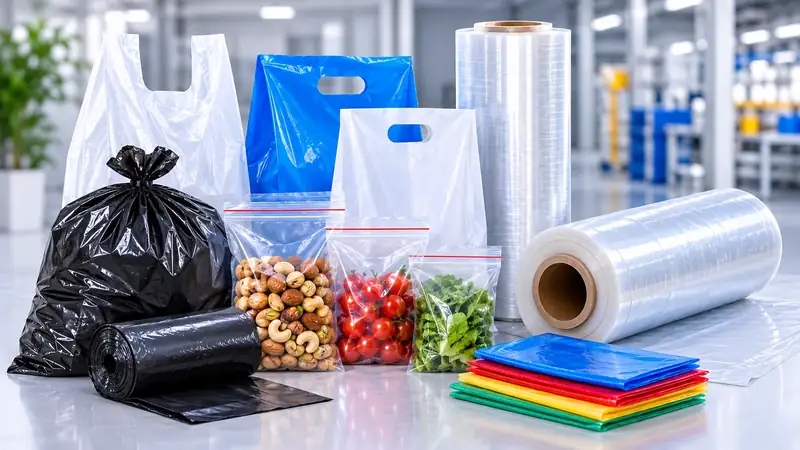
PE materials, particularly HDPE, LDPE, and LLDPE, are commonly used to manufacture shopping bags, garbage bags, and industrial plastic bags.
The selection of the polymer affects flexibility, strength, thickness, and overall product performance.
Flexible Packaging Films
LDPE, LLDPE, PP, PET, and PA are used in different types of flexible packaging films.
Depending on the application, these materials may be used individually or combined in multilayer structures to improve mechanical strength, sealing performance, and barrier properties.
Stretch and Shrink Films
LLDPE is widely used in stretch film production because of its elasticity and puncture resistance.
Shrink films can be manufactured from different polymers, including PE, PVC, and polyolefin materials, depending on the required shrink characteristics and application.
Food Packaging
PET, PP, PE, and PA are used in food packaging products.
Material selection depends on factors such as food contact compliance, moisture and oxygen barrier requirements, sealing performance, and storage conditions.
5. Polymer Additives and Masterbatch
In addition to base polymers, manufacturers often use additives and masterbatch to modify the properties and appearance of plastic products.
Masterbatch is a concentrated mixture of pigments or additives dispersed in a carrier resin. It is added during processing to achieve specific properties or colors.
Common types include:
-
Color Masterbatch: Used to produce plastic products in different colors.
-
UV Stabilizers: Help reduce material degradation caused by ultraviolet exposure.
-
Antioxidants: Help protect polymers against oxidation during processing and use.
-
Slip Additives: Reduce friction between film surfaces.
-
Anti-Blocking Additives: Help prevent plastic films from sticking together.
-
Processing Aids: Improve processing behavior and production consistency.
The appropriate additive package depends on the polymer, manufacturing process, and final product specifications.
6. Factors to Consider When Choosing Polymer Raw Materials
Selecting the right polymer is an important decision for manufacturers. Several factors should be evaluated before purchasing raw materials.
Mechanical Properties
Consider tensile strength, flexibility, impact resistance, stiffness, and puncture resistance based on the intended product.
Processing Method
Different polymers are designed for specific manufacturing processes. For example, film extrusion, injection molding, and blow molding may require different material grades.
Temperature Resistance
Evaluate the temperatures that the material will experience during production, storage, transportation, and final use.
Chemical Resistance
Some products require materials that can withstand contact with oils, cleaning agents, chemicals, or other substances.
Material Cost
Compare the price of raw materials with their performance, processing efficiency, and final product quality.
Quality and Specifications
Important specifications include:
-
Melt Flow Index (MFI)
-
Density
-
Tensile strength
-
Melting temperature
-
Moisture content
-
Additive composition
Manufacturers should review technical data sheets (TDS) and safety data sheets (SDS) before selecting and processing polymer materials.
7. Virgin and Recycled Polymer Materials
Polymer raw materials are available in both virgin and recycled forms.
Virgin Polymers are produced from newly manufactured polymer resin and are available in different grades for specific industrial applications.
Recycled Polymers are obtained through the recovery and reprocessing of plastic waste. Their properties can vary depending on the original material, recycling process, contamination level, and quality control.
Recycled materials can help reduce demand for virgin resources in suitable applications. However, manufacturers must evaluate their mechanical properties, consistency, and regulatory suitability before use.
8. Future Trends in the Polymer Industry
The polymer industry continues to develop in response to changing manufacturing requirements, environmental considerations, and technological innovation.
Some important trends include:
-
Increased use of recycled polymer materials
-
Development of recyclable packaging structures
-
Lightweight material engineering
-
Improved polymer processing technologies
-
Advanced barrier materials for packaging
-
Greater use of bio-based polymers
-
Improved production efficiency and material optimization
These developments are creating new opportunities for manufacturers to improve product performance while reducing material consumption and environmental impact.
Conclusion
Polymer raw materials are fundamental to modern manufacturing and packaging industries. Materials such as polyethylene, polypropylene, PET, PVC, polystyrene, and polyamide offer different properties and applications.
Choosing the right polymer requires understanding its mechanical characteristics, processing requirements, chemical resistance, and intended use.
For manufacturers, working with suitable raw materials and maintaining consistent quality standards are essential steps toward producing reliable, efficient, and cost-effective plastic products.